.svg)
Featured scientist: Dr Yaseera Ismail
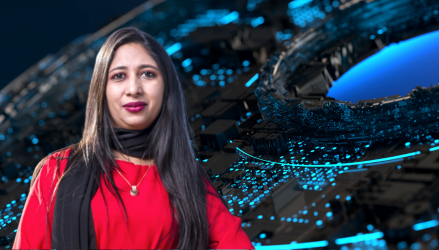
This Women’s Month, NITheCS celebrates Dr Yaseera Ismail, a quantum physicist whose research is helping to advance secure communication and strengthen South Africa’s position in quantum technology.
Dr Ismail began her research career in classical optics at the Council for Scientific and Industrial Research in Pretoria while completing her master’s degree. She later moved into quantum optics during her PhD, at a time when experimental quantum research in South Africa was still limited.
She was drawn to the field by the opportunity to explore the fundamental principles of quantum physics and translate them into technologies with practical value. Her journey later led her to establish the first quantum optics laboratory at the University of KwaZulu-Natal. She now leads the QuPhotonics Laboratory at Stellenbosch University.
Advancing Quantum Communication
Dr Ismail’s research focuses on free-space quantum communication, where quantum information is transmitted through the atmosphere using particles of light called photons.
One of the central challenges is ensuring that these fragile signals remain reliable over long distances. Atmospheric turbulence, scattering, beam movement and photon loss can weaken the signal. Her team therefore develops advanced optical systems, transmission techniques and sensitive detection methods to protect quantum information.
This research could support highly secure terrestrial and satellite communication networks. In quantum communication, any attempt to interfere with transmitted information changes its quantum state, making possible interception easier to detect.
Dr Ismail also contributed to the first quantum satellite link demonstrated in the Southern Hemisphere. The project established a 12,900-kilometre quantum-secure communication link between South Africa and China using a microsatellite.
The achievement showed that satellite-based quantum communication can operate across distances far beyond the limits of optical fibre. It also demonstrated South Africa’s ability to contribute to frontier quantum research and laid the groundwork for future infrastructure and international collaboration.
International Leadership and Recognition
Dr Ismail’s contribution to optics and quantum science extends beyond her laboratory. She serves as the Optica-appointed Vice President of the International Commission for Optics, known as the ICO.
Established in 1947, the ICO is a full member of the International Science Council and brings together territorial committees and international organisations working in optics and photonics across the world. Through this role, Dr Ismail contributes to international cooperation, scientific exchange and the continued development of optical science and technology.
In 2025, she was also recognised as one of the Quantum 100, an initiative linked to the UNESCO International Year of Quantum Science and Technology. The recognition celebrated individuals advancing quantum research, innovation and community building as the world marked 100 years of quantum mechanics.
These achievements reflect both the international significance of her work and her growing leadership within the global quantum science community.
Leading and Creating Opportunity
At the QuPhotonics Lab, Dr Ismail supervises students, develops experimental systems, secures research funding and builds international partnerships. What excites her most is transforming scientific ideas into practical technologies while training the next generation of quantum scientists and engineers.
She is currently the only female principal investigator in South Africa’s Quantum Technology Initiative. Although working in a field where women remain underrepresented has brought challenges, it has also strengthened her commitment to mentoring young scientists, particularly women.
Her message to young women is clear: quantum technology is growing rapidly, and there is space for them not only to participate, but also to lead.