.svg)
Research shows heat tames quantum fluctuations
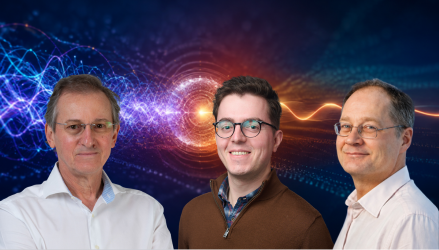
From left: Prof Francesco Petruccione (Stellenbosch University and NITheCS), Dr Graeme Pleasance (Stellenbosch University and NITheCS) and Prof Erik Aurell (KTH Royal Institute of Technology, Stockholm).
A team of physicists from Stellenbosch University, NITheCS and the KTH Royal Institute of Technology in Sweden has identified a previously overlooked mechanism that helps quantum systems lose their quantum character and behave classically at high temperatures.
The finding, published in Physical Review Letters, resolves a long-standing inconsistency in one of the most widely used models of quantum Brownian motion—a universal phenomenon whereby a quantum particle undergoes random, “jittery” motion due to its collisions with a thermal environment.
Quantum systems are extraordinarily sensitive to their surroundings. Interactions with a thermal environment cause them to lose coherence—the delicate property that allows particles to exist in multiple states at once. Understanding this process, known as decoherence, is essential both for fundamental physics and for building practical quantum technologies such as quantum computers and sensors.
The team considered a well-known model of quantum Brownian motion, in which the environment’s influence at high temperatures is usually treated as Gaussian white noise. Under this simplification, the particle’s motion can be described by the well-known Caldeira-Leggett master equation—a seminal result named after the authors of the paper in which it was first derived in the 1980s.
While this equation can often provide an adequate description of quantum Brownian motion, it is also known to violate a basic physical requirement known as “complete positivity”. The absence of this property can lead it to predict particle states characterised by negative probabilities, which lack a viable physical interpretation.
By carefully re-evaluating the decoherence kernel capturing the influence of the environment on the particle’s motion, the team derived an additional contribution to the Caldeira-Leggett master equation that restores the complete positivity of the underlying process. Interestingly, this term specifically penalises high-frequency quantum fluctuations, effectively damping the most rapidly oscillating quantum components and accelerating classicalization.
“The high-temperature limit of quantum Brownian motion has always left a mathematical loose end,” said Professor Francesco Petruccione, co-author and Pro Vice-Chancellor for Artificial Intelligence and Quantum Technologies at Stellenbosch University. “By retaining the next-to-leading contribution to the decoherence kernel, we obtain a description that is both physically consistent and independent of artificial cutoffs. High-frequency quantum noise is actively suppressed, providing a natural route from the quantum to the classical world.”
The result has important theoretical and practical implications. “Master equations tend to provide the most physically transparent description of open quantum systems, but often have to be introduced on phenomenological grounds rather than derived from first principles”, said Dr Graeme Pleasance, lead author of the study. “This has the potential downside of obscuring their validity. Our work identifies the correct structure of the master equation describing Markovian quantum Brownian motion in the semiclassical limit, which has relevance to understanding decoherence at the quantum scale.
The work was carried out by Dr Graeme Pleasance and Prof Francesco Petruccione (Stellenbosch University and NITheCS) together with Prof Erik Aurell (KTH Royal Institute of Technology, Stockholm). It was supported by the South African Quantum Technology Initiative (SA QuTI) of the Department of Science, Technology and Innovation. It appears in Physical Review Letters 137, 050405 (2026), published 29 July 2026 (DOI: 10.1103/kp9j-v4ss).