.svg)
The Origin of the First Heavy Elements
Video
Presenters

Poster
Details
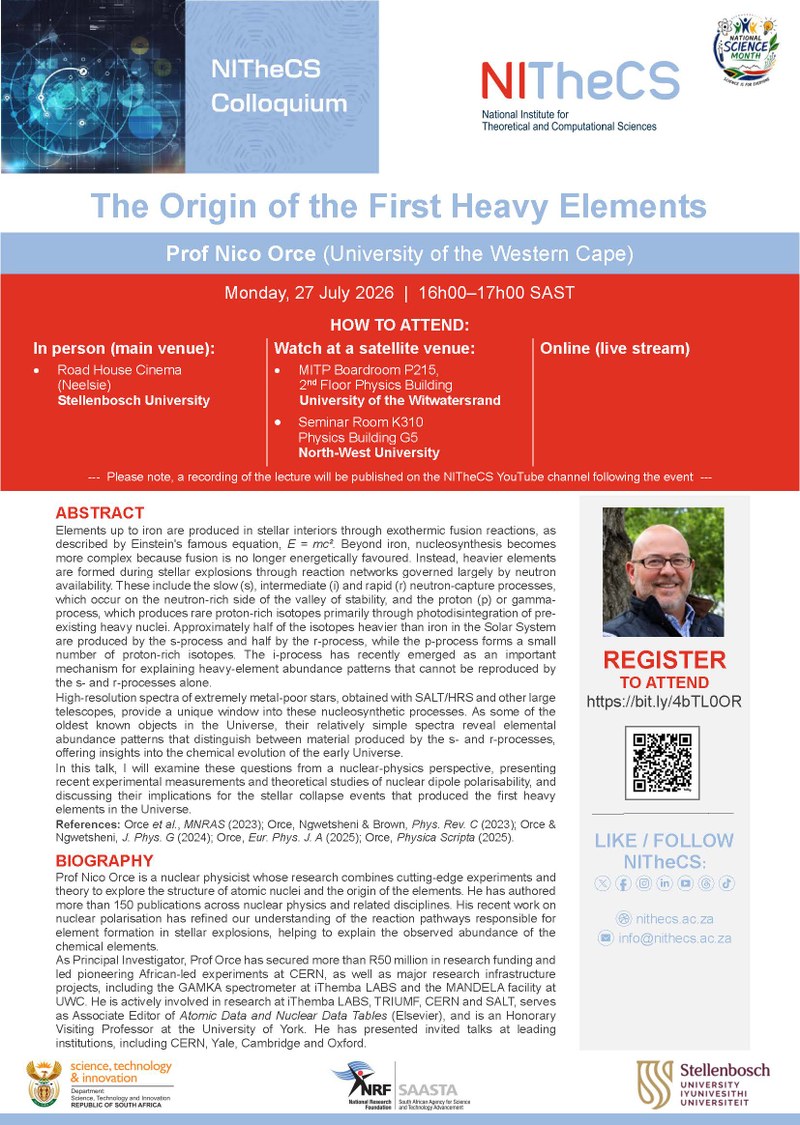
Beyond iron, nucleosynthesis becomes more complex because fusion is no longer energetically favoured. Instead, heavier elements are formed during stellar explosions through reaction networks governed largely by neutron availability. These include the slow (s), intermediate (i) and rapid (r) neutron-capture processes, which occur on the neutron-rich side of the valley of stability, and the proton (p) or gamma-process, which produces rare proton-rich isotopes primarily through photodisintegration of pre-existing heavy nuclei. Approximately half of the isotopes heavier than iron in the Solar System are produced by the s-process and half by the r-process, while the p-process forms a small number of proton-rich isotopes. The i-process has recently emerged as an important mechanism for explaining heavy-element abundance patterns that cannot be reproduced by the s- and r-processes alone.
High-resolution spectra of extremely metal-poor stars, obtained with SALT/HRS and other large telescopes, provide a unique window into these nucleosynthetic processes. As some of the oldest known objects in the Universe, their relatively simple spectra reveal elemental abundance patterns that distinguish between material produced by the s- and r-processes, offering insights into the chemical evolution of the early Universe.
In this talk, I will examine these questions from a nuclear-physics perspective, presenting recent experimental measurements and theoretical studies of nuclear dipole polarisability, and discussing their implications for the stellar collapse events that produced the first heavy elements in the Universe.
References: Orce et al., MNRAS (2023); Orce, Ngwetsheni & Brown, Phys. Rev. C (2023); Orce & Ngwetsheni, J. Phys. G (2024); Orce, Eur. Phys. J. A (2025); Orce, Physica Scripta (2025).
Alternative Viewing Locations
- Seminar Room K310, Physics Building G5, North-West University
- Online
- Room P215, 2nd Floor, Physics Building, University of the Witwatersrand
Materials