.svg)
Overcrowding and the finite N Hilbert space
Video
Presenters

Poster
Details
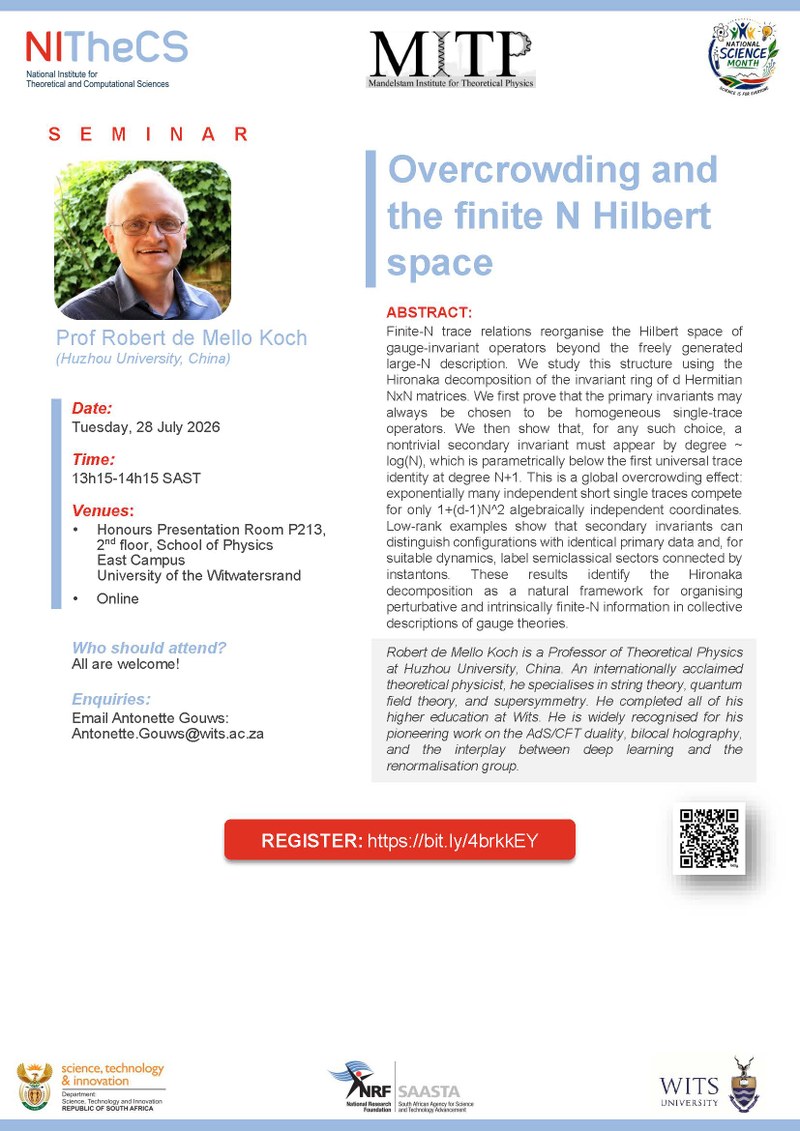
We study this structure using the Hironaka decomposition of the invariant ring of d Hermitian NxN matrices. We first prove that the primary invariants may always be chosen to be homogeneous single-trace operators. We then show that, for any such choice, a nontrivial secondary invariant must appear by degree ~ log(N), which is parametrically below the first universal trace identity at degree N+1. This is a global overcrowding effect: exponentially many independent short single traces compete for only 1+(d-1)N^2 algebraically independent coordinates. Low-rank examples show that secondary invariants can distinguish configurations with identical primary data and, for suitable dynamics, label semiclassical sectors connected by instantons. These results identify the Hironaka decomposition as a natural framework for organising perturbative and intrinsically finite-N information in collective descriptions of gauge theories.
Alternative Viewing Locations
- Online
Materials