.svg)
Reflections on the 2026 CHPC & NITheCS Coding Summer School
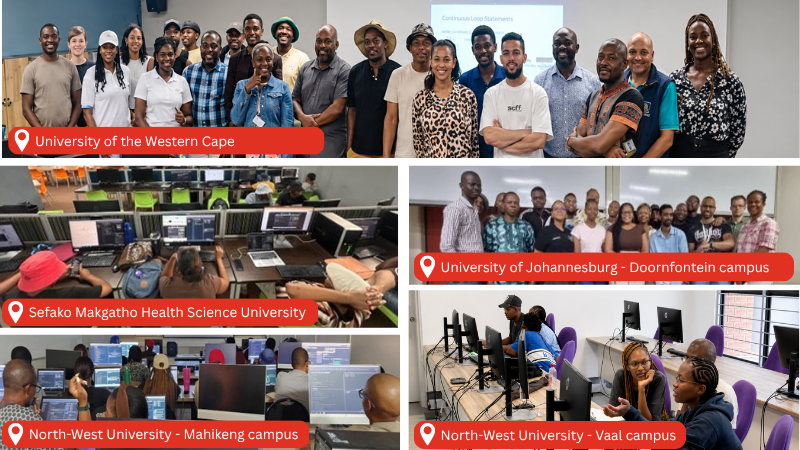
The 16th CHPC and 8th NITheCS Coding Summer School on Data Science and Machine Learning brought together students from across South Africa for two weeks of intensive training, collaboration, and hands-on computing. In a recent debrief presented by CHPC Junior Software Engineer Vuyolwethu Mfidi, the scale and impact of the 2026 school became clear: this was not merely a training programme, but a national initiative to strengthen computational capacity across a wide range of disciplines.
Held from 26 January to 6 February 2026, the Coding Summer School attracted 907 registered participants and was hosted simultaneously across 30 venues nationwide. A total of 624 students successfully completed the programme and passed the assessment.
The student cohort reflected the increasingly interdisciplinary nature of data-driven research. Participants came from fields including Computer Science, Physics, Mathematics and Statistics, Chemistry and Chemical Engineering, Biology, Environmental and Geographical Sciences, Agriculture, Engineering, as well as Business, Law, and Accounting.
A Two-Week Journey Through Data Science and Machine Learning
The programme was structured around two major themes.
During the first week, students were introduced to core concepts in Data Science. Topics included workflow management, Extract, Transform and Load (ETL) processes, exploratory data analysis and visualisation, terminal skills, and the responsible use of AI tools in research and practice.
The second week focused on Machine Learning and Artificial Intelligence. Students explored computational thinking, probability theory and statistics, as well as the fundamentals of machine learning and AI. Additional presentations enriched the programme, including sessions on Research Software Engineering by Anelda van der Walt and Peter van Heusden, and practical guidance on AI for researchers presented by Avi Moodley.
Growing Engagement Beyond the Classroom
One of the strongest indicators of student engagement was the activity on Slack, which has become an important extension of the Summer School learning environment.
Participants exchanged 3,046 messages during Week 1 and a further 1,385 messages during Week 2. The number of students actively participating on the platform also continued to grow, with 465 students posting at least once during the programme. This represents a significant increase from 386 active contributors in 2025 and 353 in 2024.
These figures suggest that the Coding Summer School is evolving into a vibrant learning community that extends well beyond lectures and practical sessions, fostering peer support, collaboration, and problem-solving.
A Return to In-Person Learning
The debrief also revealed a notable shift in attendance patterns.
Average in-person attendance increased to approximately 330 participants per day, while average attendance via Zoom dropped to around 100. This trend points to a renewed preference for face-to-face engagement and highlights the value of local facilitation, peer learning, and direct support during hands-on coding training.
Daily attendance across participating institutions remained consistently high throughout the two weeks, ranging from just over 300 to nearly 380 students per day.
Recognising Student Excellence
The Summer School also celebrated outstanding student achievement through a series of awards.
The Pythonista Awards were presented to:
- Cesky Nengudza (University of Venda)
- Grace van Heerden (University of Cape Town)
- Philasande Tshusha (Cape Peninsula University of Technology)
The Streamlit Awards were awarded to:
- Venerate Mdaka (University of Mpumalanga)
- Nagessar Kaveer (University of Pretoria)
The Slacker Awards, recognising exceptional engagement on Slack, went to:
- Thendo Ravele (University of Venda), who contributed 132 posts
- Arno Smith (North-West University, Potchefstroom Campus), who contributed 70 posts
These awards highlighted both technical achievement and active participation within the learning community.
Lessons for the Future
The debrief also identified opportunities for further improvement.
Student feedback indicated that some participants would have preferred more time to explore machine learning topics, with several commenting that the content was highly condensed. Feedback also suggested that while the statistics lecture was particularly helpful for newcomers, it may not have fully aligned with the intended level of the programme.
Additional recommendations included incorporating more practical applications during Week 1 and improving alignment and continuity between lecturers during Week 2.
Strengthening South Africa’s Computational Research Ecosystem
The success of the 2026 Coding Summer School underscores the growing importance of data science, machine learning, and computational thinking across South Africa's research landscape.
For NITheCS, the programme reflects a broader commitment to developing the theoretical, computational, and analytical skills required to advance research across disciplines, from science and engineering to finance, agriculture, health, and beyond.
As highlighted in Vuyolwethu Mfidi's debrief, the statistics tell only part of the story. The true impact lies in the hundreds of students who completed the programme with greater confidence in their coding abilities, a deeper understanding of data-driven methods, and a clearer appreciation of how computational approaches can enhance research in their respective fields.
With participation continuing to grow and engagement reaching new levels, the Coding Summer School remains an important pillar in building South Africa's next generation of computational researchers.