.svg)
New book highlights climate crisis
A new book, co-authored by Prof Guy Midgley (SU), offers critical insights into the climate change challenges facing Southern Africa.
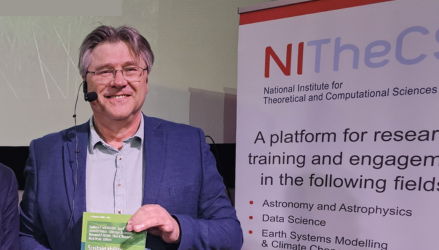
As world leaders and negotiators gather in Azerbaijan for COP29, the urgency of addressing the global climate crisis has never been clearer. Southern Africa is already experiencing the escalating impacts of climate change, with increased frequency and intensity of heatwaves, droughts, floods and extreme weather. These events, driven by long-term shifts in temperature and weather patterns due to the burning of fossil fuels, pose a significant threat to the region’s unique ecosystems and the livelihoods they support. Early discussions at COP29 (the 29th Conference of the Parties to the UN Framework Convention on Climate Change, 11-22 November 2024) have focused on evaluating global progress towards the 2015 Paris Agreement’s goal of limiting global warming to 1.5 degrees Celsius above pre-industrial levels. This is crucial to avoid the most catastrophic impacts of climate change.
However, contentious issues, including increased ambition on emission reduction targets and the fulfilment of climate finance pledges, particularly for vulnerable nations, remain key points of debate. Critical insights available to all In light of these challenges, a new book offers critical insights into the climate change challenges facing Southern Africa and the science-based interventions needed to safeguard its unique ecosystems. Sustainability of Southern African Ecosystems under Global Change: Science for management and policy interventions, published by Springer, provides a comprehensive analysis of the region’s vulnerability to climate change and outlines potential solutions. The book is nearly 1,000 pages long, with 32 chapters organised into five thematic sections but, because it is open access, anyone can download a complete electronic copy free of charge.
Born out of two programmes funded by Germany’s Federal Ministry of Education and Research (BMBF), the book tackles a wide range of environmental issues, from the impacts of ocean currents on climate systems to how small-scale farmers can adapt to climate change. This collaborative effort, spanning a decade and involving hundreds of researchers from Africa and Europe, represents a significant contribution from the scientific community to understanding and addressing the complex environmental challenges facing Southern Africa. Stellenbosch University’s Professor Guy Midgley, acting director of the School for Climate Studies and one of the book’s editors, on 11 November illuminated the book’s key findings at a colloquium hosted by South Africa’s National Institute for Theoretical and Computational Sciences (NITheCS).
He emphasised the urgency of the situation, stating that, “we can see the whites of the eyes of climate change now”. Midgley praised the significant investment made by the BMBF, which spent some €60 million (about US$63.6 million) on Science Partnerships for the Adaptation to Complex Earth System Processes (SPACES and SPACES II) over a decade. This funding, he explained, enabled the researchers to tackle critical questions previously unexplored in Southern Africa, generating “an enormous amount of new information”. He described the research as “cutting-edge science, much of it developed here in Africa,” underscoring the importance of local expertise in tackling the continent’s unique challenges. A region on the climate change frontline Southern Africa, a globally important biodiversity hotspot, faces a multitude of threats from global change, with climate change posing a particularly significant challenge. The book underscores the region’s unique vulnerabilities, including:
“This is not a standard northern hemisphere challenge. It is our challenge, and we need to do our science to address it and develop our own models,” Midgley said. Science for solutions Despite these challenges, the book offers a message of hope, accentuating the power of science to inform effective management and policy interventions. Key areas highlighted include: Bridging science and policy One of the book’s strengths lies in its commitment to bridging the gap between scientific research and policy action. Each chapter identifies clear policy implications, presenting complex scientific findings in an accessible manner. This is achieved through concise summaries of existing knowledge and the integration of the latest research from SPACES. A call to action Midgley insisted that scientific findings should be translated into policy action. He called for increased investment in African-led climate change research, noting that the continent currently receives less than 3% of global funding in this area, with only half of that going to African researchers.
“This book is a valuable resource for our negotiators in the climate change halls of battle,” he stated. It provides compelling evidence for the urgent need to limit global warming and invest in adaptation measures to protect Southern Africa’s unique ecosystems and the livelihoods they support.” Who should read this book? While directly aimed at policymakers, the book is a valuable resource for a wider audience. Midgley focused on its importance for lecturers and students seeking to understand the complexities of climate change in Southern Africa and contribute to future research. The book’s interdisciplinary approach and clear language make it relevant to anyone interested in the environmental challenges facing the region, including researchers, conservationists and concerned citizens. The need for integrated research The book draws attention to the need for ongoing, interdisciplinary research to provide a deeper understanding of the linkages between ocean-climate-land interactions, biogeochemical processes and the thresholds of change.
By addressing these complex interactions, researchers can provide more comprehensive and robust policy recommendations for sustainable ecosystem management in the face of global change. This research should also consider the social and economic dimensions of environmental change, recognising the complex interplay between human activities and ecosystem health. ‘Overshoot’ likely Midgley cautioned against the dangers of an “overshoot” scenario, where global temperatures rise significantly above the 1.5°C target before eventually being brought back down. He pointed out that, while previous hopes rested on avoiding a significant overshoot by 2050, current trends suggest a more pessimistic outlook. A graph shown by Midgley during his presentation shows projections for global temperature rises under different change scenarios.
Such an overshoot, he warned, would have devastating consequences for Southern Africa and the rest of the world, leading to the loss of invaluable species and irreversible damage to ecosystems. Midgley stressed the urgent need to fight for ambitious climate action to avoid such a scenario and protect the region’s unique biodiversity. COP by the book? As COP29 unfolds, the insights presented in this book offer a timely reminder of the stakes involved and the crucial role of science in forging a sustainable path forward. Since the book is freely available online, it provides a valuable resource for policymakers, researchers, and anyone concerned about the future of Southern Africa in a changing climate. This article was first published on University World News – Africa Edition on 14 November 2024