.svg)
A lunar radio astronomy array built in Africa
'The first all-African space exploration mission, Africa2Moon, is to be launched to the lunar south pole with the Chang’e-8 mission scheduled for 2029.'
NITheCS Associate Dr Adriana Marais and her co-authors outline an ambitious new chapter in African space science in their article below, published in Nature on 14 August 2026.
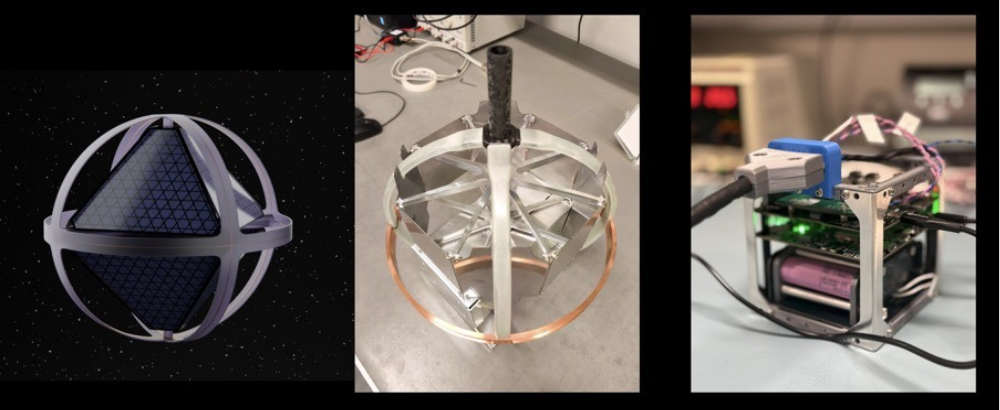
Left: a computer-generated simplified representation of one of the BALLS, including three concentric orthogonal loop antennas, eight solar panels and a contained electronics box. Centre and right: the structural and electrical functional test models.
'The rapid development of radio astronomy in Africa, driven largely by the Square Kilometre Array and precursor instruments like MeerKAT, has positioned the continent as an important contributor to global space science. As African institutions strengthen expertise in radio instrumentation, data processing, systems engineering and analysis, there is growing interest in extending these capabilities to space-based radio astronomy.
In April 2025, the Foundation for Space Development Africa’s Africa2Moon technology demonstrator, a three-antenna low-frequency lunar radio astronomy array, was selected for launch to the lunar south pole aboard the Chinese National Space Administration’s Chang’e-8 mission. Aiming to become the first radio interferometer on the lunar surface, the instrument is being developed by expert volunteers in collaboration with the South African Radio Astronomy Observatory, the South African National Space Agency, the National Institute for Theoretical and Computational Sciences and institutions across Africa. It. In partnership with Petrawell, the Aerospace Systems Research Institute at the University of KwaZulu-Natal and the Electronic Systems Laboratory at Stellenbosch University, structural and electrical functional models were assembled in May 2026 for shipment to the Chang’e-8 team in China for testing.
Understanding the Universe
For a century, radio astronomy has transformed our understanding of the Universe, revealing phenomena inaccessible at other wavelengths while opening new observational windows. However, the sub-20 MHz frequency band remains largely unexplored with Earth's atmosphere almost completely opaque to wavelengths longer than ~15 m, depending on solar elevation. Observations at these frequencies are therefore best performed beyond Earth. The Moon provides a unique platform owing to its negligible atmosphere and, on the lunar farside at night, exceptional shielding from terrestrial radio interference and solar emissions, making it the most radio-quiet environment in our vicinity.
The Africa2Moon concept is a low-cost, low-mass, low-frequency array of distributed Bounced African Low Lunar Spheres (BALLS), each comprising three concentric orthogonal loop antennas, a central electronics box and outer solar panels (Figure 1). Each of the BALLS functions as an omnidirectional magnetic antenna based on the small-loop antenna concept. When a loop’s circumference is less than approximately one-tenth of the operating wavelength, it behaves as a small magnetic dipole with a far-field radiation pattern normal to the plane of the loop. A tuning capacitor cancels the loop’s inductive reactance at the desired frequency, bringing it into resonance, maximising sensitivity while limiting bandwidth. The BALLS are deployed by free-rolling across the lunar surface to form an interferometric array for detecting long-wavelength radio signals.
Mission requirements
The Africa2Moon technology demonstrator, adapted to Chang’e-8 mission requirements, consists of three 30 cm diameter BALLS each less than 4 kg. Expected to be operational for at least 6 Earth days, each of the BALLS operates as an independent radio receiver of sub-20 MHz signals with local power, processing and telemetry. A lander-based management unit provides common timing and position information and relays telemetry and science data to Earth through the lander communication system and deep-space network.
Preliminary analysis indicates array sensitivities of approximately 10⁻¹⁸ Wm⁻²Hz⁻¹ at 10 MHz and 10⁻¹⁹ Wm⁻²Hz⁻¹ at 20 MHz. The demonstrator will observe the Earth, the Sun, the Galactic background and the lunar surface as well as search for sub-20 MHz technosignatures. The three-BALLS array will serve as a pathfinder for future lunar radio astronomy and as a technology demonstrator for the full Africa2Moon mission, which aims to deploy 55 antennas on the lunar farside, one for each African nation.
Beyond its scientific objectives, Africa2Moon is a platform for skills development and technological innovation within Africa’s growing space sector. By engaging students, universities, research institutions and engineering companies in developing space-based instrumentation, the project expands expertise in radio engineering, systems integration and space mission design while supporting STEM education and inspiring the next generation of scientists and engineers. As radio astronomy expands through international collaborations on Earth and in space, Africa2Moon demonstrates how innovative instrumentation and continental collaboration can advance scientific discovery while strengthening regional research ecosystems. As the first all-African space exploration mission, it represents an important step in Africa’s participation in space science and exploration.'
By Adriana Marais*1,2,3, Carla Sharpe Mitchell1,4, Eugene Avenant5, Hendrik Burger6, Michael Johnston4, Thomas Kusel4, Japie Ludick4, Oleg Smirnov4,7,8,9,10
* Corresponding author. Email: adriana.marais@nithecs.ac.za
1Foundation for Space Development Africa; Cape Town, 8000, South Africa.
2National Institute for Theoretical and Computational Sciences; Stellenbosch, 7602, South Africa.
3School for Data Science and Computational Thinking, Stellenbosch University; Stellenbosch, 7599, South Africa. 4South African Radio Astronomy Observatory; Cape Town, 7925, South Africa.
5South African National Space Agency; Pretoria, 0184, South Africa.
6CubeSpace; Stellenbosch, 7600, South Africa.
7Department of Physics and Electronics, Rhodes University; Makhanda, 6140, South Africa.
8Institute for Radioastronomy, National Institute of Astrophysics (INAF IRA); Via Gobetti 101, 40129 Bologna, Italy.
9Astrophysics, Department of Physics, University of Oxford, Keble Road, Oxford, OX1 3RH, UK.
10Breakthrough Listen, Astrophysics, Department of Physics, University of Oxford, Keble Road, Oxford, OX1 3RH, UK.