.svg)
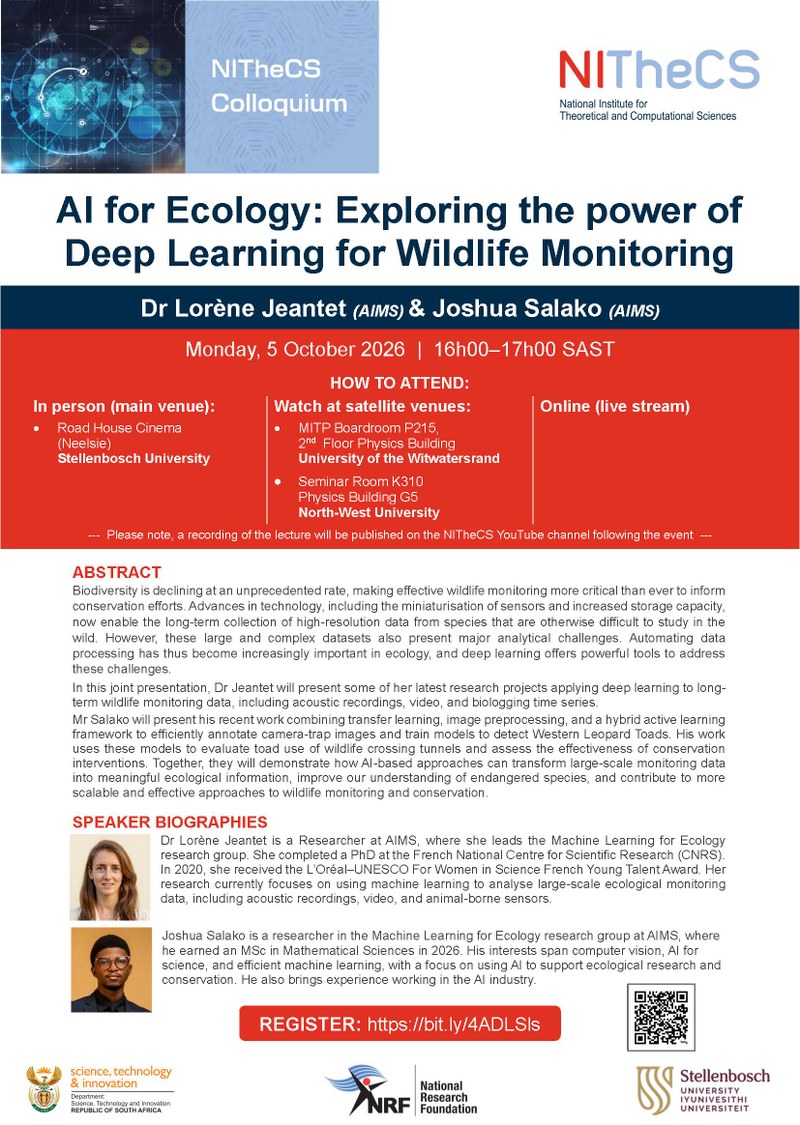
AI for Ecology: Exploring the power of Deep Learning for Wildlife Monitoring

Poster
Details
Advances in technology, including the miniaturisation of sensors and increased storage capacity, now enable the long-term collection of high-resolution data from species that are otherwise difficult to study in the wild. However, these large and complex datasets also present major analytical challenges. Automating data processing has thus become increasingly important in ecology, and deep learning offers powerful tools to address these challenges.
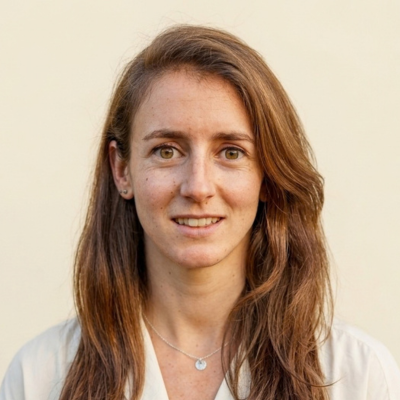
In this joint presentation, Dr Jeantet will present some of her latest research projects applying deep learning to long-term wildlife monitoring data, including acoustic recordings, video, and biologging time series.
Mr Salako will present his recent work combining transfer learning, image preprocessing, and a hybrid active learning framework to efficiently annotate camera-trap images and train models to detect Western Leopard Toads. His work uses these models to evaluate toad use of wildlife crossing tunnels and assess the effectiveness of conservation interventions. Together, they will demonstrate how AI-based approaches can transform large-scale monitoring data into meaningful ecological information, improve our understanding of endangered species, and contribute to more scalable and effective approaches to wildlife monitoring and conservation.
Alternative Viewing Locations
- Online
- Room P215, 2nd Floor, Physics Building, University of the Witwatersrand
- Seminar Room K310, Physics Building G5, North-West University
Materials