.svg)
Modelling the glucose-insulin system for diabetes: problems and perspectives
Presenters

Poster
Details
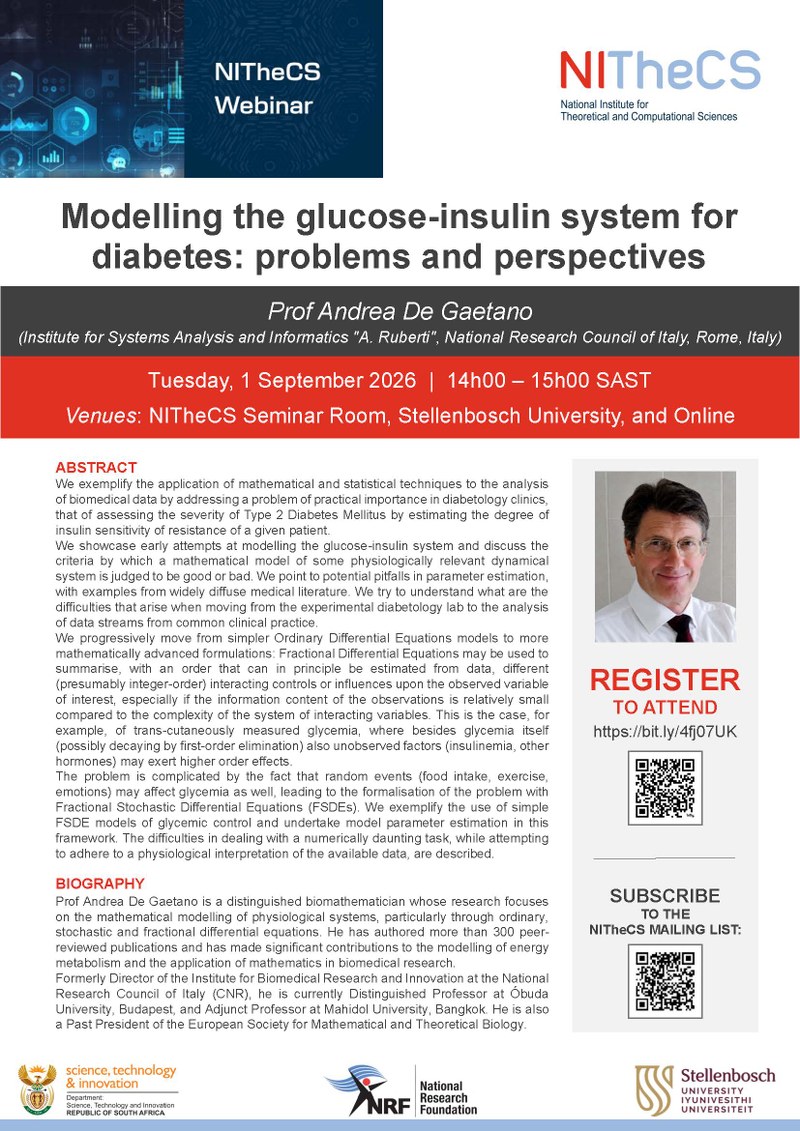
We showcase early attempts at modelling the glucose-insulin system and discuss the criteria by which a mathematical model of some physiologically relevant dynamical system is judged to be good or bad. We point to potential pitfalls in parameter estimation, with examples from widely diffuse medical literature. We try to understand what are the difficulties that arise when moving from the experimental diabetology lab to the analysis of data streams from common clinical practice.
We progressively move from simpler Ordinary Differential Equations models to more mathematically advanced formulations: Fractional Differential Equations may be used to summarise, with an order that can in principle be estimated from data, different (presumably integer-order) interacting controls or influences upon the observed variable of interest, especially if the information content of the observations is relatively small compared to the complexity of the system of interacting variables. This is the case, for example, of trans-cutaneously measured glycemia, where besides glycemia itself (possibly decaying by first-order elimination) also unobserved factors (insulinemia, other hormones) may exert higher order effects.
The problem is complicated by the fact that random events (food intake, exercise, emotions) may affect glycemia as well, leading to the formalisation of the problem with Fractional Stochastic Differential Equations (FSDEs). We exemplify the use of simple FSDE models of glycemic control and undertake model parameter estimation in this framework. The difficulties in dealing with a numerically daunting task, while attempting to adhere to a physiological interpretation of the available data, are described.
Materials