.svg)
Opening address at IndabaX 2025
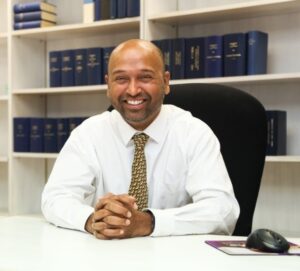
Artificial intelligence (AI), machine learning (ML) and deep learning are ‘the backbone of transformative endeavours across science, industry, and society.’ So said Prof Kanshu Rajaratnam, Director of the School for Data Science & Computational Thinking at Stellenbosch University, who delivered the opening address at IndabaX 2025 on 7 July 2025.
He said AI, ML, and deep learning are no longer academic abstractions – they are now driving real-world impact. In science, they enable breakthroughs from climate prediction to faster drug discovery. In industry, they are transforming finance, logistics, and manufacturing by boosting efficiency and creating new value. Across society, they power advances in healthcare diagnostics, precision agriculture, and even help shape more inclusive public policy.
‘Yet with great power comes great responsibility: we must confront ethical challenges such as bias, explainability, data privacy, and algorithmic transparency. As stewards of technology, we bear the duty to ensure our innovations serve all people equitably and preserve human dignity,’ he added.
He commented that NITheCS is an institution deeply connected with IndabaX and reminded the audience that the Institute operates as a consortium across all public South African universities.
‘It advances through three main pillars:
- Research: tackling fundamental and application‑driven questions across the theoretical and computational sciences.
- Training: building talent pipelines from honours students to postdoctoral scholars and early career researchers.
- Engagement: offering colloquia, mini‑schools, internships, and public lectures—ensuring our work remains connected with society.
‘The goal is clear: to elevate South Africa’s academic and technological leadership, address UN Sustainable Development Goals, and forge equitable participation in science across our communities.’
Prof Rajaratnam continued: ‘Within this landscape, the School for Data Science & Computational Thinking, launched in July 2019, serves as Stellenbosch University’s flagship for AI‑related work. It houses several strategic centres and labs:
- CERI – Centre for Epidemic Response & Innovation
- SACEMA – the South African Centre for Epidemiological Modelling & Analysis
- Policy Innovation Lab
- Industry-sponsored chairs: Standard Bank Lab Research Chair, Capitec Chair in Applied AI.
The School fosters high‑impact research and teaching in Africa: training honours, masters and doctoral students; building partnerships with government and industry; and producing published work in top‑tier journals and conferences.
Prof Rajaratnam stressed that ‘peppered throughout the School and NITheCS, the interdisciplinary approach distinguishes this community. Whether modelling disease spread, responding to climate challenges, deploying recommender systems in finance, or shaping public policy: AI and ML are tools of enormous positive potential – when guided by ethical guardrails and societal reflection.’