.svg)
Featured scientist: Prof R Du Toit Strauss
‘For the typical person the effect of cosmic radiation plays no role in her or his everyday life. However, we are all affected by the fact that, once we are beyond the protective bubble formed by the Earth’s atmosphere and geomagnetic field, the radiation due to these cosmic particles becomes a serious health concern. This particularly affects flight crew and astronauts on board the International Space Station, but even more so for planned crewed missions to the Moon, Mars, and eventually destinations beyond our solar system. Therefore, the goal of our cosmic ray research is to be able to model and predict these radiation levels and thereby mitigate any harmful effects,’ says physicist Prof R Du Toit Strauss of North-West University (NWU) and Head of Node (North) of NITheCS.
‘My work focuses on simulating the transport of charged particles through turbulent magnetised plasmas. We apply our theoretical ideas and models to the transport of solar energetic particles that are released spontaneously from the Sun, and that are guided and scattered by the Sun’s magnetic field to reach Earth. Here, these high-energy charged particles present radiation risk to astronauts and flight crew.’
His current work built on work done during his study years, says Du Toit: ‘For my MSc and PhD degrees I worked with Marius Potgieter and Stefan Ferreira to develop models that can simulate the transport of cosmic rays through the heliosphere. The interaction between these charged particles and the turbulent heliospheric plasma makes this a rather complicated problem to solve and generally requires numerical solutions. Since then, I have worked almost exclusively on developing and applying such numerical models to a variety of problems and applying these to a variety of different particle populations. I seem to have a knack for the numerical and computational work, and on top of this, I like how the modellers are the link between the theoreticians and experimentalist who, very often, don’t speak the same language. It has also allowed me to work on data from a number of spacecraft missions, most notable the two Voyager spacecraft and, more recently, the Parker Solar Probe and Solar Orbiter spacecraft.’
Space science yesterday, today and tomorrow
Du Toit says: ‘At a recent conference a colleague remarked that we are living in the Golden Age of space science. I don’t quite agree with him; I think the Golden Age was in the 1960s and 1970s with the Voyager spacecraft being launched after the successful Apollo programme. I would say that we are now in a Platinum Age of space science: after a delay of several decades, we are now building on the discoveries and technological advances made during the 1970s. We have already witnessed a number of remarkable discoveries: from Voyager exploring the outermost regions of the heliosphere to the Parker Solar Probe exploring the innermost regions of the Solar System. In between those, there is a whole fleet of spacecraft and research missions. And we will return to the Moon in the near future.’
The NASA Space Launch System (SLS), a super heavy-lift rocket designed for deep space exploration, is capable of sending the Orion spacecraft, astronauts and cargo directly to the Moon in a single launch. ‘As part of the Artemis programme, the SLS will help to construct the Lunar gateway and, eventually, power the Orion spacecraft back to the Moon. And this is just the start: plans for a crewed mission to Mars are moving ahead fast. I’m due to officially retire in 2050 and strongly believe that I will see astronauts on the Martian surface before then. And the best part: I get to contribute in my very own small way by studying cosmic radiation!’
Du Toit adds that South Africa makes an important contribution in this regard: ‘The South African Space Agency (SANSA) drives space weather research in South Africa, developing models to predict potentially harmful space weather effects. Important for us, their work includes studying the exposure of airline flight crew to cosmic radiation from space.’
From a teacher’s influence to becoming a professor
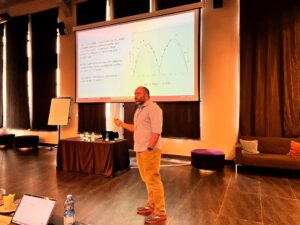
Prof Du Toit Strauss lectureReflecting on the path to his current position, Du Toit says: ‘I can clearly recall what lead me to follow a career in science. This was due to the most influential person, in my opinion, in a scientist’s life: her or his primary school science teacher. In my case this person was Ms Marina Steenkamp. In addition to her usual Grade 6 classes, she offered her students a number of extra-curricular science-based activities, including participation in the local Expo for Young Scientists. This science fair was where I first got introduced to the scientific method, experimentation, and interpreting results.’
He continues: ‘My science project for the Expo was selected for the national finals. After the fair, I found a letter containing an invitation to publish extracts from my project in the quarterly Archimedes science magazine available at school libraries and science classrooms. I was delighted when my few pages of text, printed it out on my mom’s dot-matrix printer and illustrated with a few hand-drawn figures, was accepted. It was an unexpected bonus that I actually got paid for it, and seeing my “research” in print was the proudest moment of my life. And I was hooked on science.’
In 2003 Du Toit enrolled for the degree BSc in Physics, Mathematics, and Applied Mathematics at the Potchefstroom campus of NWU. ‘I would never have guessed that, 20 years later, I would still be living in the same small university town! After my BSc degree, came BSc Hons, MSc, and a PhD at the same university. Then the most significant event in my academic career happened: our physics department opened a number of academic positions, including that of Junior Lecturer. I applied for it and gladly accepted the position when it was offered to me. What followed where promotions to Lecturer (2011), Senior Lecturer (2014), Associate Professor (2019) and, finally, to full Professor early in 2022.’
Du Toit believes the experience of research in both the European and American contexts helped him in finding his own research niche and fine-tuning his own approach to teaching and research. ‘Very early in my career it became clear that international research visits would be essential to combat academic inbreeding. My first post-PhD visit was to the Ruhr University in Bochum, Germany, where I was awarded an Alexander von Humboldt grant to work with Horst Fichtner. I settled on developing a new model that could simulate the transport of solar energetic particles and ended up spending six very productive months in Bochum, culminating in the publication of our new model in Strauss and Fichtner (2015). Early 2015, I was awarded a Fulbright fellowship to spend three months at the University of Alabama in Huntsville to work with Kobus le Roux, who is an expert on the theory of particle transport. I felt I should gain some more experience in this sub-field. A number of publications have resulted from this collaboration that continues to this day.’
- Interdisciplinary collaboration and NITheCS
‘I cannot image that South Africa will launch interplanetary spacecraft missions in the foreseeable future: such scientific efforts cannot be accommodated in a developing country. Scientists are often forced either to change their areas of specialisation or emigrate to wealthier countries to pursue their research passion. Sadly, this contributes towards the “brain drain” in the developing world. However, I must emphasize that some aspects of the South African funding approach are very positive. Developed counties could learn a thing or two about effectively funding post-graduate students and how to combine community outreach projects as a funding requirement.’
Du Toit believes the really difficult research questions require answering extremely difficult and multi-faceted research problems. ‘These days it is impossible to tackle such projects alone or in a traditional, narrow-focused, research group. No research individual or group has the required knowledge, on their own, to solve such complex problems. There are many examples of this in physics. For example, when studying the formation of the universe, we will need input from cosmologists, astronomers and astrophysicists to provide data and unique observations, applied mathematicians to develop complex numerical simulation models, and in some cases, computational scientists to apply machine learning techniques to analyse the very big datasets. Only by working together in a coherent multi-disciplinary group can they hope to solve the research problem. This is the future of research and NITheCS embodies this idea of unstructured research.
He comments on his role as Head of Node at NITheCS: ‘I see my role as being that of a facilitator: bringing together researchers in very different fields to work on multidisciplinary projects. NITheCS will drive such projects at the NWU, but also at the North-node as a whole. The role of NITheCS in student training can also not be overlooked: our students at the NWU benefit immensely from opportunities such as the yearly CHPC programming workshop. Students are equipped with critically important skills that help them become world-class researchers.’