.svg)
Featured scientist: Prof Hugo Touchette
Exciting work is emerging at the intersection of machine learning/AI and physics. A Nobel Prize was given for works in ML inspired by physics
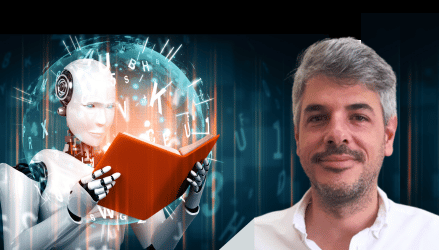
‘There’s a lot of interesting work now at the intersection of machine learning/artificial intelligence (ML/AI) and physics. Last year’s Nobel Prize was given for works in ML that was inspired by physics,’ says Prof Hugo Touchette, Professor of Applied Mathematics in the Department of Mathematical Sciences at Stellenbosch University (SU). He elaborates on the subject: ‘It is clear that ML and AI are impacting society in positive and negative ways. For instance, the development of productivity tools like ChatGPT is positive, but leads to a corresponding loss of jobs done by humans, which is disruptive. Scientists working in ML and AI, including physicists, are aware of these issues. They’re not only trying to develop models and technology in ML and AI, but also trying to minimise their negative impact. There are groups of scientists and policy makers set up across the world to evaluate the dangers and impact of ML and develop guidelines for their use.’
He adds: ‘This is a very important issue to which physicists can contribute, I think, with their experience of safety issues and organisations relating to atomic and nuclear energy.’ Prof Touchette says the challenges in this field include ‘teaching ML/AI at university level and developing courses and programmes for this. SU created the first MSc programme on ML/AI in South Africa, which is taught in collaboration with Applied Maths, Computer Science, and Electrical Engineering.’ Other challenges include ‘incorporating basic symmetries and conservation laws in ML/AI models to make sure that they model physics correctly. This goes by the name of “Physics informed ML/AI”. There is also the need to develop ML-based methods for simulating the evolution of many-particle systems, classical or quantum.’
Own research Prof Touchette’s research focuses on phenomena that are random and unpredictable: noisy dynamical systems, turbulence, coin tossing, finance, the weather and more. He is trained as a physicist, but now works mostly at the interface of probability theory, statistical physics and, more recently, machine learning. His main specialty is the theory of large deviations – a branch of probability theory used to estimate the probability of very rare events arising in random systems as diverse as gases, queues, random walks, information systems or nonequilibrium systems driven by noise and external forces. He has written a review article on the many applications of this theory in statistical physics. One project that Prof Touchette currently works on uses reinforcement learning techniques for optimising the simulation of rare events in stochastic systems, with applications in physics, engineering, and finance. This project is done in collaboration with Dr Grant Rotskoff (Department of Chemistry, Stanford University, USA) and Daniël Cloete, an MSc student at SU.
At the moment, he is also writing a book on ‘Transformations and Symmetries of Markov Processes’ with Dr Raphael Chetrite from the University of Nice in France (due to be published in 2026). His path to date Prof Touchette was born in Québec, Canada and completed his undergraduate studies in Physics at Sherbrooke University, Québec (1992-1997). He then studied for a Master’s in Science in Mechanical Engineering at MIT (USA) and was awarded his PhD in Physics from McGill University, Montréal (2004). He is grateful to his supervisors at undergraduate MSc and PhD levels for acting as his mentors. ‘They introduced me to new people and institutions where I later went on to study.’ From 2004 until 2006 he worked as a postdoctoral researcher at the School of Mathematical Sciences, Queen Mary University of London (UK), and then as a lecturer at the School of Mathematical Sciences, Queen Mary University of London, UK.
In 2013 he became Chief Researcher at the National Institute for Theoretical Physics (NITheP – now NITheCS). ‘Since then, I’ve been re-orienting my research and teaching towards ML and AI. I’m especially interested in using recent ML techniques to develop models of physical systems and simulate them efficiently.’ He took up his current position at SU in 2018. He is also the interim director of the MSc in ML and AI at SU and serves on the university’s Senate Research Ethics Committee. On being a scientist ‘I enjoy working as a professor and scientist for many reasons, but the one that stands out for me is teaching students in subjects that are interesting and new to them. I find this especially useful in South Africa, as we see first-hand the effect that having a degree has on young people. We’re also teaching now the first generation of scientists in SA working in ML and AI,’ says Prof Touchette.
He also likes doing research because of the ‘surprise of discovering new results and the freedom involved in setting one’s own research work with other people.’ He points out that ‘ML/AI is an interdisciplinary field: it involves researchers from many different fields (computer science, physics, cognitive science, etc.) who work together to develop computational models and techniques that I believe would not exist without this collaboration. We have a similar level of collaboration at SU, with people from Computer Science, Electrical and Electronic Engineering, and Applied Maths working on ML projects. The School of Data Science also has researchers from computer science and social sciences working on ML and AI advice and policies for government.’ His advice for a successful career as researcher? ‘Be ambitious, throw yourself into your favourite subject without counting time, and go and work with the best people in that subject, wherever they may be.’